Give IAS a goal.IAS keeps humans in control.
IAS turns rough intent into a useful outcome you can inspect. Start a local CLI run around Codex or Claude Code.
reviewable
Every run stays reviewable.
Inspect a run's outcome, assumptions, and artifacts without digging through a transcript. Runs are read-only by default; explicit writing tasks use an isolated worktree.
Example
local execution
Run IAS on your machine.
Run records live in local state outside your repository. Selected context and task data go to your signed-in provider.
Example
context
Only the context that can change the answer.
A run should gather the smallest high-signal context and show what it included and left out before it acts. You can correct that choice without restarting the goal.
Example
approval
Irreversible steps wait for a person.
A person can inspect and redirect the work. Hard floors block. Ordinary reversible uncertainty does not become a permission queue.
approval required
Apply change to main?
Example
example evidence
The record is the result, not a screenshot.
A useful run returns the outcome, the material decisions, the artifacts, and what remains uncertain. You should not need transcript archaeology to know what happened.
historical evidence
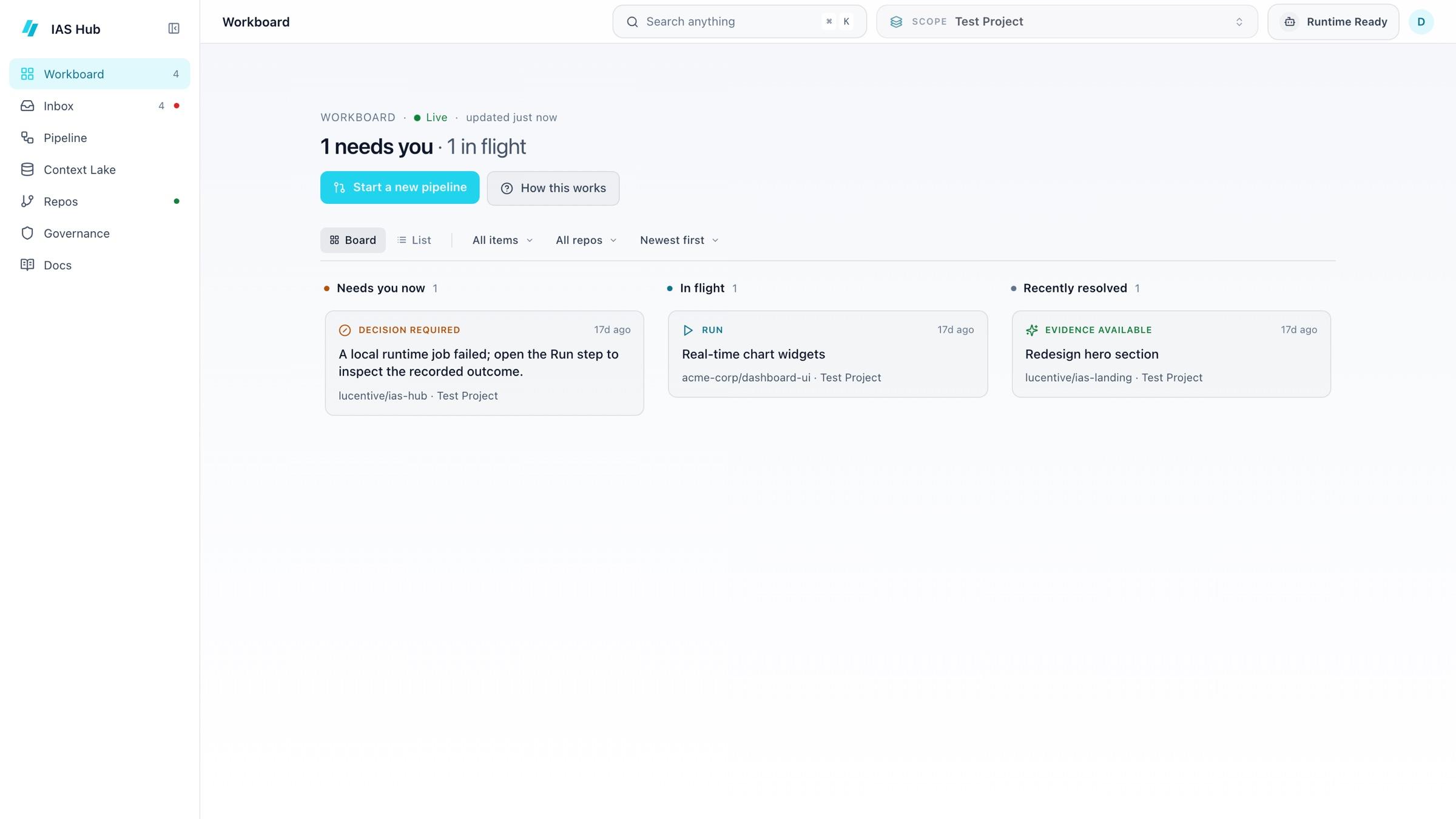
See the governed run.
A historical Hub workboard shows a run's progress and the questions that needed a person's answer. Inspect local CLI runs through their intent, context, checks, and evidence.
next step
Read how a run works.
Read the docs to see how a local run handles intent, context, checks, and evidence. Share the tour with the person who runs your agents.
Read the docs